
Executive Summary:
Roommate Syndrome occurs when couples prioritize logistical efficiency over emotional and physical intimacy, leading to a state of disconnection. Recovery requires a shift from "co-managing" to Relational Mindfulness, prioritizing Bids for Connection, and maintaining a healthy balance between togetherness and separateness through the expansion of Love Maps.

Couples can experience relational dysfunction when managing the household becomes the primary function of the relationship.
The Efficiency Trap in the Denver Household
For the successful Denver professional, efficiency is a virtue. Whether you are navigating the legal corridors of LoDo, managing a tech firm in the DTC, or overseeing a private equity portfolio in Cherry Creek, your ability to optimize and execute is the engine of your success. But what happens when you’re playing your marriage like a never ending game of house? You’ve really only mastered the "business" side of your relationship, right? The mortgage is paid, the kids are enrolled in the right schools, and the shared Google calendar is a masterpiece of coordination.
Yet, when you crawl into bed at night, you feel a profound sense of isolation. You have become "Roommates with a Mortgage." I’m Russ Crowe, and at Blueprint Relationship Therapy, I’ve seen plenty of couples who run their lives like a well oiled machine but their relationship is running on empty. The gap you are feeling is the result of functional disconnection, where the logistics of life have smothered the "air" required for intimacy.
I’m Russ Crowe, MFTC, and I spent 10 years working in consulting and tech before becoming a relationship counselor. I know what it’s like to tackle projects and deadlines, all while trying to balance your relationship or a family at home.
The Relational Reality: When "Efficient" Management Becomes Relational Atrophy
Most wellness blogs suggest that the solution to "Roommate Syndrome" is simply "more communication" or a weekly date night. While not inherently bad, these are surface-level solutions. The reality is that your relationship has likely fallen into a state of relational atrophy. You have stopped being curious about each other because you assume you already have the "data."
In the Gottman Method, we call the internal database you keep about your partner a Love Map. In the early days, you updated this map daily. It’s fun. It’s exciting. In the "Roommate Phase," you stop. You stop turning toward their Bids for Connection—the small, everyday attempts they make for your attention—because you are too busy "managing" the household. Sometimes it’s intentional but many times, you simply stopped paying attention.
Usually, if we’re being honest, it feels easier to focus on things that won’t touch the loneliness we feel in our heart. We spend our energy looking outside our relationship because to look in it, we must acknowledge there’s a profound dysfunction. Whether it’s relational baggage you don’t want to bring up or power dynamics that feel too sensitive to rebalance, it can feel a little scary to dig underneath the surface of the relationship. This is where couples therapy can be truly helpful.
The Passion Triangle: Intimacy, Thrill, and Sensuality
To understand how the spark dies, we must look at the Passion Triangle, a framework that identifies the three essential components of a vibrant relationship: Intimacy (closeness), Thrill (romance), and Sensuality (touch).
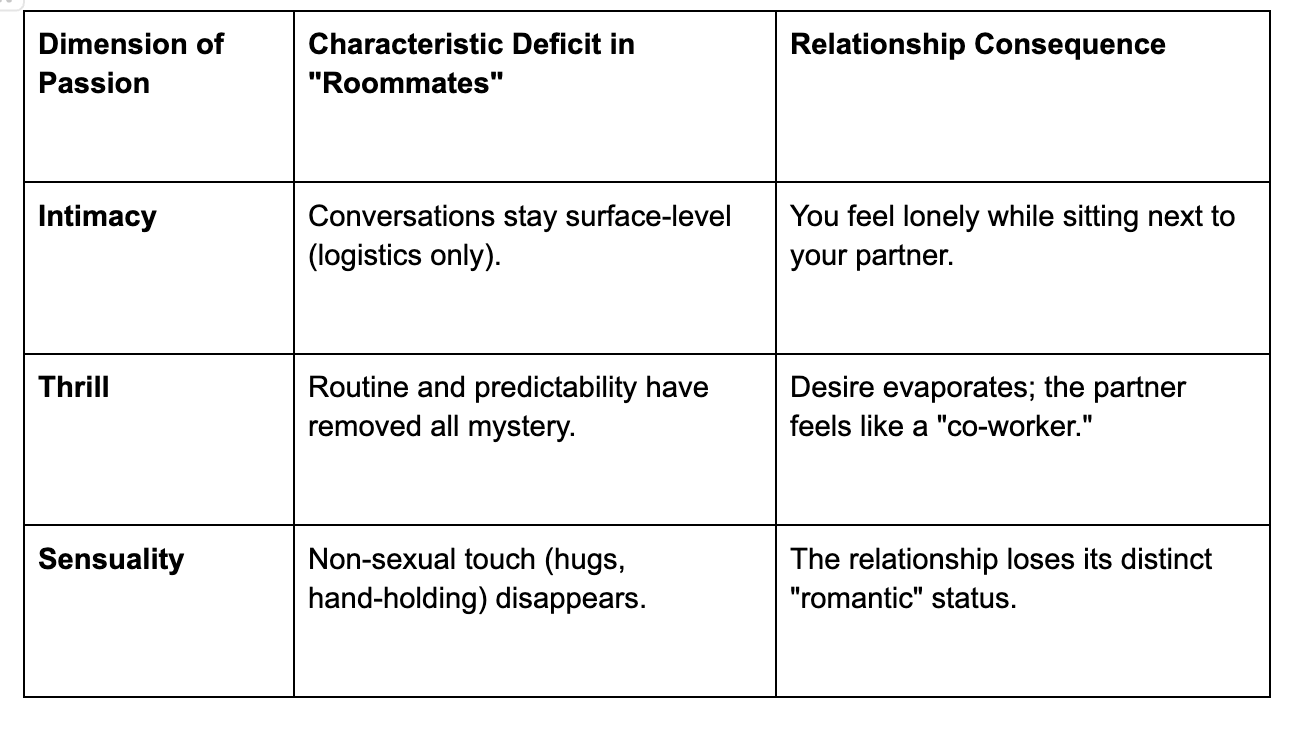
The Passion Triangle along with its impact on relationships
Why "Fire Needs Air": The Power of Differentiation
Clinical pioneer Esther Perel highlights a central paradox in modern marriage: we want our partner to offer stability and safety, yet we also want them to provide mystery and adventure. In Denver's high-performance culture or if we’re operating as parents, we often emphasize safety. We want our partner to be our "everything"—best friend, co-parent, and financial partner.
This leads to a state of relational fusion, where the "I" is lost in the "We." But for connection to thrive, there must be a gap to bridge. "Fire needs air". Passion requires a level of differentiation—the ability to maintain your own sense of self while remaining connected to another. When you are too "fused," there can be little room for safety, which can cause a lack of curiosity to know each other’s inner worlds.
Actionable Insights: Moving from Co-Managers to Passionate Partners
The Six-Second Kiss: Research shows that a six-second kiss is long enough to create a transition from the stress of the day to the safety of the relationship. It’s a "kiss with potential.”
Prioritize Non-Sexual Touch: Re-establish the "physical" side of the triangle through non-demand touch—holding hands while watching a show or a long hug when arriving home. It doesn’t have to lead to anything else.
The "No-Logistics" Date: When you go out, set a boundary: limit talking about the kids’ logistics, house projects, or the budgets. Focus on Thrill and Adventure—try a new activity together, like a cooking class or a hike at Red Rocks, to spark novelty. This is a chance to remake your new relationship.
Express "Positive Needs": Instead of criticizing what is missing, state a positive need. Say, "I really miss the feeling of your hand in mine; can we sit together tonight?".
Conclusion: Rebuilding the Foundation
Roommate Syndrome is not a sign that your love has died; it is a sign that your relational system is running on empty. You achieved your professional success because you knew when to call in an expert to optimize your business. Your relationship deserves the same level of strategic investment. At Blueprint Relationship Therapy, we help you move beyond the "chore list" to rebuild a partnership that is not just efficient, but extraordinary. We can help you relearn each other’s inner worlds and build a culture that focuses on growth and curiosity.
Works Cited
Perel, E. (2006). Mating in Captivity: Unlocking Erotic Intelligence. Harper.
Rusnak, K. (2025). "The Six Second Kiss." The Gottman Institute.
"Common Advice for Couples in 2025: Bids for Connection." The Gottman Institute.
"Roommate Syndrome in Marriage: Identifying Functional Disconnection." South Denver Therapy.
"10 Ways to Rekindle the Passion in Your Marriage." The Gottman Institute.
Fraser, C. (2025). "The Passion Triangle: Reclaiming Thrill and Sensuality." The Gottman Institute.
Perel, E. (2025). "Letters from Esther: Searching for Connection in a Disconnected Era." Esther Perel's Blog.
"The Magic 5:1 Ratio: Predictors of Relationship Stability." The Gottman Institute.
Perel, E. "The Paradox of Choice and Intimacy in the Modern Metacrisis." Esther Perel's Blog.
"Intimacy and Connection: The Power of Small Things Often." The Gottman Institute.
"Date Night Ideas in Denver To Foster Connection With Your Partner." Mindful Counseling Denver.
